


Montreal's Diamond District is useful, but it is not a guarantee.
A cluster of jewellers, diamond sellers and ateliers can give you access to options. It cannot tell you which diamond belongs in your ring, which certificate details matter, or when a larger stone is quietly the weaker choice.
That judgement comes from experience.
Atelier RMR is located at Phillips Square, in the heart of Montreal's jewellery district. From here, we meet clients at every stage of the process: some are buying their first engagement ring, some are comparing natural and lab-grown diamonds, and others are redesigning a family stone into something they can wear every day.
The most important lesson is simple: a diamond should not be chosen as an isolated object. It should be chosen for a person, a hand, a setting, a budget and a life.
Where Is Montreal's Diamond District?
Montreal's Diamond District is commonly associated with Phillips Square in downtown Montreal, near Sainte-Catherine Street and the city's historic commercial core.
The area has long been connected to jewellery, diamonds, fine retail and appointment-based shopping. Today, buyers come to Phillips Square to compare stones, meet jewellers, explore engagement rings and begin custom jewellery projects.
That concentration is valuable. It gives clients access.
But access is not the same as expertise.
A district can help you see more diamonds. It cannot automatically help you choose better.
The Diamond District Is a Starting Point, Not a Shortcut
The biggest misconception about any diamond district is that location alone creates value.
It does not.
A diamond district can be helpful because there are more options in one place. But more options can also create more confusion. Buyers are often shown stones that look similar on paper but feel very different in person.
Two diamonds can have the same carat weight, colour and clarity. One can look lively, balanced and elegant. The other can look flat, deep, narrow or awkward once it is placed beside a hand or imagined in a ring.
This is why shopping by numbers alone is risky.
The certificate matters. The price matters. The carat weight matters. But none of them matter in isolation.
The Mistake Most Buyers Make: Starting With Carat Weight
Carat weight is the easiest number to understand, so buyers often start there.
That is usually the wrong place to begin.
A larger diamond is not automatically a better diamond. Sometimes it is simply heavier in the wrong areas. A stone can carry weight in its depth, face up smaller than expected, or lose brightness because its proportions are not working well.
A smaller diamond with better cut, better spread and better proportions can often look more refined than a larger stone chosen only for size.
Atelier RMR does not look at carat weight first.
We look at whether the diamond makes visual sense.
Does it face up beautifully? Does it return light well? Does the outline feel balanced? Are the inclusions visible or harmless? Does the colour work with the metal? Will the stone suit the setting? Will the ring feel elegant on the hand?
Those questions matter more than chasing a number.
What We Look at Before Carat Weight
Before focusing on size, we look at the characteristics that determine whether a diamond will actually look good in a finished ring.
1. Face-up presence
Some diamonds look larger than their weight suggests. Others look smaller. Measurements, shape and proportions affect how much visual presence the stone has when viewed from above.
This is especially important for oval, emerald, pear, radiant and cushion cuts.
2. Cut and light return
A diamond should not only be white, clean or large. It should have life.
Cut quality affects brilliance, contrast, fire and the way the stone moves in changing light. A diamond with weak light return can feel dull even if its certificate looks impressive.
3. Shape and outline
For fancy shapes, outline is critical.
An oval can feel graceful or bulky. A pear can feel elegant or bottom-heavy. An emerald cut can feel architectural or lifeless. A cushion can feel soft and romantic or poorly defined.
The certificate will not fully judge that for you.
4. Clarity position
Clarity grade is not the whole story.
Where the inclusion sits matters. A small inclusion near the edge may be easier to hide or ignore. An inclusion under the table may be more visible. Two diamonds with the same clarity grade can have very different visual cleanliness.
5. Colour in the chosen metal
Colour should be judged in context.
A slightly warmer diamond can look beautiful in yellow gold. A whiter stone may matter more in platinum or white gold. The goal is not always to buy the highest colour grade possible. The goal is to choose the colour that supports the design.
6. Proportions for the setting
The diamond has to work with the ring.
A low bezel, a delicate solitaire, a hidden halo, a three-stone design and a wedding-band stack may each call for a different stone choice. A diamond that looks impressive loose may not be the right stone for the final piece.
7. Budget allocation
Sometimes the best decision is not to spend more on the diamond.
It may be wiser to choose a slightly more modest stone and invest in a better setting, stronger craftsmanship or a design that feels more personal. A ring is not only a diamond holder. It is an object that has to be made well.
What Makes a Diamond Expensive but Not Necessarily Better
A diamond can be expensive for reasons that may or may not matter to you.
Higher colour, higher clarity and larger size can all increase price. But not every upgrade creates a visible improvement.
For example, paying for a clarity grade that looks identical to the naked eye may not be the best use of budget. Choosing a larger diamond with weaker proportions may create a less beautiful result. Prioritizing a high colour grade may matter less if the stone is going into yellow gold.
This is where serious guidance helps.
The goal is not to buy the most expensive diamond your budget allows. The goal is to understand where the budget creates visible value.
Natural vs Lab-Grown Diamonds: The Question Is Value
The natural vs lab-grown conversation is often treated as a moral debate. We think that is too simplistic.
Natural diamonds and lab-grown diamonds can both be beautiful. Both can be certified. Both can be used in fine jewellery. The right choice depends on what the client values.
A natural diamond may appeal to someone who values geological rarity, tradition and the emotional character of a stone formed by nature.
A lab-grown diamond may appeal to someone who wants a larger visual result, a specific size or a different budget strategy.
Neither choice should be made casually.
The right question is not "Which one is better?"
The right question is: "Which one makes sense for this client, this ring and this budget?"
Red Flags When Shopping in a Diamond District
A diamond district gives buyers options, but it also requires discernment.
Be cautious if the conversation feels rushed, vague or overly focused on closing the sale. A serious diamond purchase should allow room for comparison and explanation.
Watch for these red flags:
- The discussion focuses almost entirely on carat weight
- Certification is unclear or treated as unimportant
- You are pressured to decide immediately
- The diamond is not discussed in relation to the setting
- You are not shown meaningful comparisons
- The explanation relies on generic phrases like "best quality"
- The price is attractive, but the details are incomplete
- The seller cannot clearly explain the tradeoffs
A good appointment should make you feel more informed, not more pressured.
What a Serious Diamond Appointment Should Feel Like
A serious diamond appointment is calm, structured and precise.
You should understand why one diamond costs more than another. You should be able to compare stones side by side. You should know what you are gaining and what you are compromising.
The conversation should include the ring, not only the stone.
Will the diamond sit high or low? Will it work with a wedding band? Does the setting protect the stone? Will the proportions flatter the hand? Is the design delicate in a way that is still durable? Does the ring feel like the person who will wear it?
That is the difference between buying a diamond and creating a piece of jewellery.
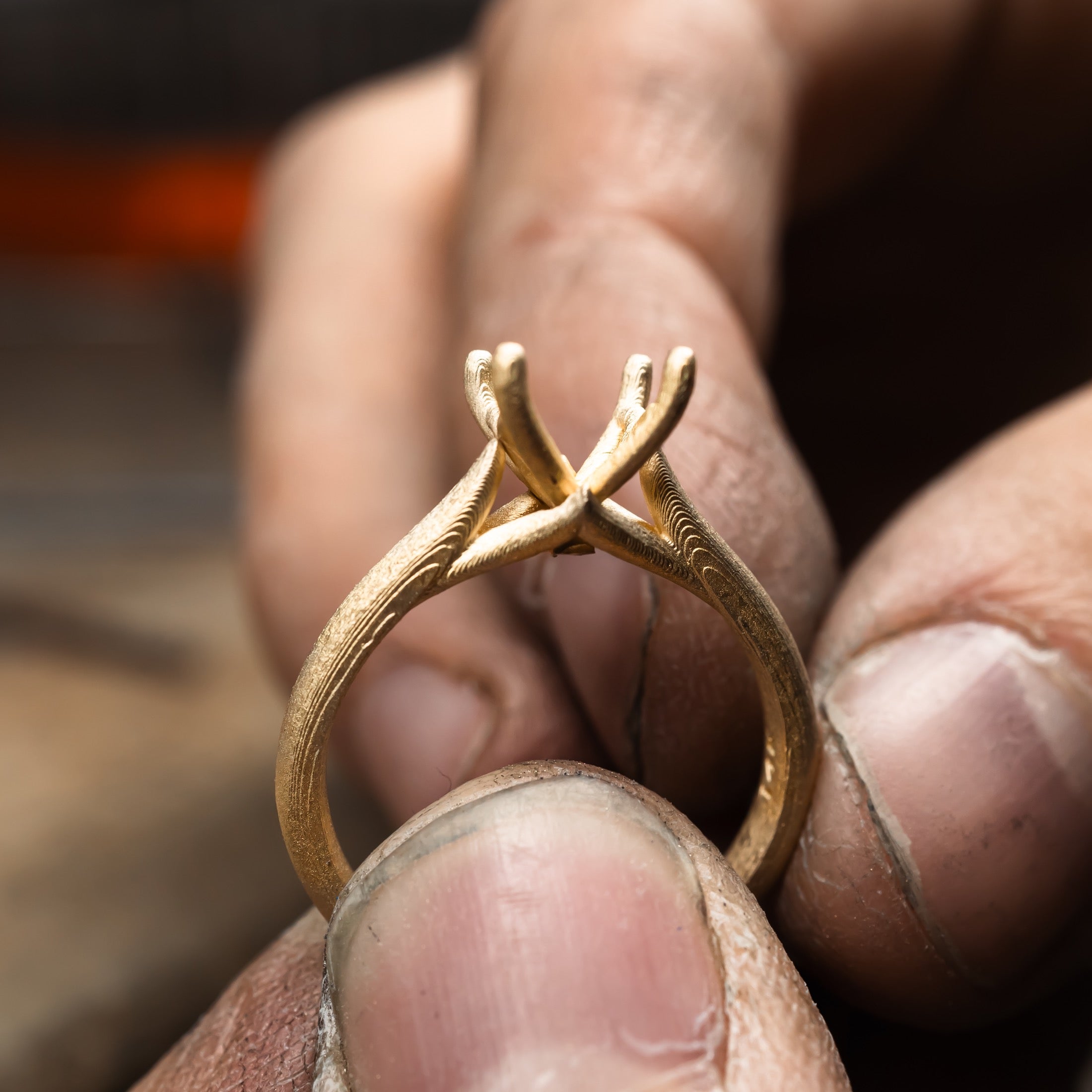
Why an Atelier Perspective Matters
An atelier does not look at the diamond as a commodity only.
We look at it as part of a finished object.
At Atelier RMR, the diamond selection is connected to design, fabrication and wearability. The stone has to work with the architecture of the ring. It has to make sense in the chosen metal. It has to support the style of the piece without creating problems later.
This matters because many choices that seem small at the diamond stage become important once the ring is made.
A stone that is too deep may force a higher setting. A shape with awkward proportions may make the ring harder to balance. A fragile design may look beautiful in a render but feel impractical for daily wear.
The best diamond choice is not theoretical. It is practical, visual and personal.
When We Recommend Spending Less
A premium jeweller should be able to tell you when not to spend more.
There are moments when upgrading is worthwhile. There are also moments when it is not.
We may recommend spending less if the visible difference is minimal, if the extra budget would be better used in the setting, or if a slightly different stone gives a more balanced result.
For example, a client may not need the highest clarity available if a lower clarity diamond is clean to the eye. A client may not need a larger stone if the proportions feel less elegant. A client may not need a certain colour grade if the ring is being made in yellow gold.
Good advice is not always about adding cost. Sometimes it is about protecting the client from paying for details that do not improve the final piece.
How to Prepare Before Visiting Montreal's Diamond District
Before visiting Phillips Square or booking a diamond appointment, it helps to prepare a few details.
You do not need to know everything. You should simply know enough to guide the conversation.
Bring or consider:
- Your approximate budget
- Preferred diamond shape, if any
- Natural, lab-grown or open to both
- Metal preference
- Ring size, if known
- Lifestyle details, especially for daily wear
- Inspiration images
- Whether the wedding band should sit flush
- Any family stones or heirloom jewellery involved
The more context you bring, the better the guidance can be.
Atelier RMR at Phillips Square
Atelier RMR is located at Phillips Square in downtown Montreal, within the city's jewellery and diamond district.
Our approach is appointment-based, design-aware and precise. We help clients compare diamonds, understand tradeoffs and create rings that feel considered from every angle.
For engagement rings, that means choosing the centre stone, setting style, proportions, metal and details together. For custom jewellery, it means thinking about the stone, the story, the structure and the way the piece will be worn.
We do not believe a diamond should be chosen only because it looks impressive on paper.
It should be chosen because it belongs in the piece.
Final Thought
Montreal's Diamond District is worth visiting. Phillips Square gives buyers access to diamonds, jewellers and expertise in one downtown area.
But the district is only the beginning.
The real value comes from knowing how to compare stones, how to read beyond the certificate, how to avoid paying for invisible upgrades and how to connect the diamond to the finished ring.
A serious diamond purchase should feel clear, not rushed. It should feel informed, not overwhelming. Most of all, it should lead to a piece that still feels right years later.
If you are choosing a diamond or planning a custom engagement ring in Montreal, Atelier RMR can guide you through the process with precision, transparency and a strong design point of view.
Book a private appointment at Atelier RMR in Phillips Square to compare diamonds and begin your custom jewellery project.